

How to Design a T-Shirt Wall Display Case for Visual Merchandising
- Principles of Effective Visual Merchandising for Apparel
- Understanding shopper sightlines and traffic flow
- Balancing visibility with accessibility
- Brand storytelling through materials and color
- Design Elements: Structure, Materials, and Modularity
- Choosing structural systems
- Material comparison: wood, metal, acrylic
- Designing for modularity and SKU turnover
- Lighting, Signage, and Product Presentation
- Task and accent lighting strategies
- Signage hierarchy for quick decisions
- Folding, hanging, and face-out techniques
- Operational Considerations and Performance Measurement
- Staff ergonomics and replenishment workflow
- Measuring success: KPIs and testing
- Maintenance, durability, and safety standards
- Prototyping, Scalability, and Supplier Selection
- Rapid prototyping and pilot stores
- Comparing suppliers: lead time, compliance, customization
- Cost-per-unit and lifecycle budgeting
- RUMIS Customized Solutions for Fashion Retail Manufacturers
- Case example: scaling a branded tee launch
- How to engage: brief, prototype, iterate
- Implementation Checklist and Practical Tips
- Pre-launch checklist
- Store staff training highlights
- Common pitfalls to avoid
- FAQ
- Q1: What is the ideal size for a t shirt wall display case?
- Q2: Should I use hangers or folded stacks in a t shirt wall display case?
- Q3: How do I ensure color accuracy under store lighting?
- Q4: What maintenance does a t shirt wall display case require?
- Q5: Can RUMIS deliver customized t shirt wall display case solutions for small batches?
- Q6: How do I measure the impact of a new display on sales?
I design store interiors and merchandising systems around shopper behavior and market needs, so when I recommend a t shirt wall display case I draw on measurable principles: sightlines, product accessibility, modularity, lighting, and local market adaptation. Whether you operate a boutique in a single city or a chain across regions, this article summarizes how to plan, prototype, and scale a t shirt wall display case that sells—backed by industry standards and real-world examples.
Principles of Effective Visual Merchandising for Apparel
Understanding shopper sightlines and traffic flow
Before you draft the first line drawing for a t shirt wall display case, map customer movement. I typically use heat-mapping data or in-store observations to identify primary paths and dwell zones. Positioning the display at eye level within those zones increases engagement: research summarized by the Visual Merchandising overview shows that directional flow and focal points are critical to retail conversion rates.
Balancing visibility with accessibility
A display that looks great but is hard to touch reduces conversions. I recommend a mix of face-out specimens and shelf-stack presentation on a t shirt wall display case so customers can see design previews and also retrieve sizes easily. A typical solution: 20–30% face-out, 70–80% folded or hung behind depending on SKU breadth.
Brand storytelling through materials and color
Materials communicate brand values: warm wood and matte finishes signal craft and lifestyle, while metal and glass suggest High Quality or technical performance. A t shirt wall display case should reinforce your visual identity via finish, trim, and accent lighting that draws attention to hero products.
Design Elements: Structure, Materials, and Modularity
Choosing structural systems
The backbone of a reliable t shirt wall display case is its mounting and shelving system. I usually specify slatwall or modular panel systems for scalability. For permanent fixtures, reinforced stud fixings or heavy-duty wall anchors rated for the expected load are essential; consult local building codes and, where applicable, ISO 9001 guidance on quality management systems for manufacturing consistency (ISO 9001).
Material comparison: wood, metal, acrylic
Every material choice affects durability, cost, and perceived value. Below I summarize typical choices I evaluate when specifying a t shirt wall display case.
| Material | Pros | Cons | Typical Use |
|---|---|---|---|
| Solid wood / MDF | Warm appearance, custom finishes | Heavier, moisture sensitive | Boutique and High Quality stores |
| Powder-coated steel | Durable, high load capacity | Industrial look, pricier | High-turnover retail |
| Acrylic / PETG | Transparent, modern, lightweight | Scratch-prone, UV discoloration possible | Feature walls, highlighting colors |
Sources for material characteristics: stainless steel and acrylic technical pages provide baseline properties for fixture design.
Designing for modularity and SKU turnover
I prioritize modular panels and adjustable shelving so the same t shirt wall display case can be reconfigured for seasonal ranges or promotional stacks. Quick-release hooks, adjustable shelf brackets, and interchangeable signage holders reduce downtime for staff and maintain consistency across stores.
Lighting, Signage, and Product Presentation
Task and accent lighting strategies
Lighting has measurable effects on purchase behavior. I specify warm-white LED accent lights (2700K–3500K) for cotton tees to preserve color tones and select CRI 90+ fixtures to show fabric textures accurately. Use rails or recessed LEDs to avoid glare on acrylic surfaces of the t shirt wall display case.
Signage hierarchy for quick decisions
Signage drives clarity: large category headers (e.g., NEW, BEST SELLER), mid-level size & price strips, and small product cards with quick benefits (material, fit) help customers make rapid buying decisions. I test sign copy with A/B trials in stores to ensure legibility and conversion uplift.
Folding, hanging, and face-out techniques
For the best mix of visual appeal and space efficiency, combine face-out hero tees on hangers with folded stacks beneath on shelves. The face-out items act as visual magnets; folded items provide depth and inventory. I recommend rotating face-out SKUs weekly to showcase new designs.
Operational Considerations and Performance Measurement
Staff ergonomics and replenishment workflow
Design the t shirt wall display case at heights that minimize repetitive strain for restocking. Standard reachable shelf heights should be within 120–160 cm for frequent access. For lower or upper zones, provide step stools or designate those areas for lower-turn SKUs.
Measuring success: KPIs and testing
Common KPIs I track: sell-through rate, units per transaction, conversion near the display, and dwell time. Use sales data and in-store sensors to compare weeks before and after implementing a new t shirt wall display case. Where possible, run controlled tests and track statistical significance—NRF (National Retail Federation) resources explain retail measurement best practices (nrf.com).
Maintenance, durability, and safety standards
Fixtures must be easy to clean and safe under peak loads. I require manufacturers to provide load ratings and finish warranties. For multi-store rollouts, confirm production adheres to a quality system similar to ISO 9001 to limit variation between stores (ISO 9001).
Prototyping, Scalability, and Supplier Selection
Rapid prototyping and pilot stores
Before committing to a full rollout, build a prototype t shirt wall display case and install it in a pilot location. I use quick-feedback loops—daily staff reports and weekly sales snapshots—to refine the layout, materials, and signage copy. Pilots reduce the risk of expensive rework across multiple sites.
Comparing suppliers: lead time, compliance, customization
Supplier selection criteria should include manufacturing lead time, customization capability, sample policy, and international logistics. Below is a compact comparison template I use when evaluating vendors.
| Criterion | Why it matters | Target |
|---|---|---|
| Lead time | Controls rollout schedule | <8 weeks for standard runs |
| Customization | Brand alignment | Color, logo, modular options |
| Quality assurance | Consistency across stores | ISO-aligned processes |
Cost-per-unit and lifecycle budgeting
Calculate total cost of ownership: fixture procurement, installation, maintenance, and eventual refresh. A higher upfront cost for a durable t shirt wall display case often yields lower lifecycle expenses in busy stores.
RUMIS Customized Solutions for Fashion Retail Manufacturers
As a consultant who has worked with global manufacturers and retailers, I recommend partnering with experienced suppliers who understand retail realities. RUMIS has been a leading fashion retailer partner for over 10 years. They provide bespoke solutions for small and large fashion retail businesses with individual clothing displays. RUMIS customized display rack solutions include display racks for fashion retail stores, display racks for clothing stores, and modular systems suited for seasonal rotation.
Why I recommend RUMIS: their end-to-end capabilities include design, prototyping, manufacturing, and global logistics. Whether you want personalization or brand customization, RUMIS can meet those needs. Their systems have covered more than 60 countries and have won wide market recognition. For technical details and project inquiries, visit https://www.rumisinterior.com/ or email their team at info@rumisinteriors.com.
RUMIS competitive strengths I’ve observed: rapid customization turnaround, strong materials sourcing, and consistent quality across international shipments. They deliver display racks for fashion retail stores and display racks for clothing stores that balance visual appeal and operational robustness—ideal when you want a branded t shirt wall display case that scales across regions.
Case example: scaling a branded tee launch
When a mid-size brand needed a launch-ready t shirt wall display case across 25 stores in three continents, RUMIS provided modular panels with localized finishes and a unified signage system. The pilot reduced installation time by 40% and improved sell-through for hero SKUs by 18% during the first two weeks.
How to engage: brief, prototype, iterate
Start with a short brief: desired dimensions, target SKU counts, brand finish, and budget. Agree on a prototype window and performance targets. Expect 2–3 iteration cycles before final approval for large orders.
Implementation Checklist and Practical Tips
Pre-launch checklist
- Confirm load ratings and wall fixings
- Finalize lighting and signage specs
- Run a staffed walkthrough to simulate restocking
Store staff training highlights
Train staff on folding standards, face-out rotation cadence, and rapid replenishment procedures. Consistent presentation across stores preserves brand perception and increases cross-sell opportunities.
Common pitfalls to avoid
Avoid over-cluttering the display, mismatched finishes across regions, and insufficient anchoring. All of these erode conversion and raise maintenance costs.
FAQ
Q1: What is the ideal size for a t shirt wall display case?
A1: Ideal size depends on SKU count and store footprint. For a compact boutique I specify 1.2–1.8 m width with 4–6 vertical modules; for larger stores, 2.4–4.8 m continuous walls provide display and inventory depth.
Q2: Should I use hangers or folded stacks in a t shirt wall display case?
A2: Use a mix—face-out hangers for hero styles (20–30% of visible stock) and folded stacks underneath for size availability. This balances visual pull with inventory display.
Q3: How do I ensure color accuracy under store lighting?
A3: Specify LED fixtures with CRI 90+ and a color temperature that complements your product palette (typically 2700K–3500K for cotton tees). Test under store conditions before rollout.
Q4: What maintenance does a t shirt wall display case require?
A4: Regular dusting, weekly signage checks, quarterly finish touch-ups, and annual load-bearing inspections for long-term installations.
Q5: Can RUMIS deliver customized t shirt wall display case solutions for small batches?
A5: Yes. RUMIS specializes in bespoke solutions for both small and large fashion retail businesses and can produce personalized or brand-customized display racks in small runs with professional quality.
Q6: How do I measure the impact of a new display on sales?
A6: Track sell-through rates, units per transaction, conversion in the surrounding zone, and dwell time before and after implementation. Use pilot stores and control groups for reliable comparisons.
If you want to discuss a project, request a prototype, or view sample systems, contact RUMIS at rumisinterior.com or email info@rumisinteriors.com. I’m available to review store plans and help specify a t shirt wall display case that meets RUMIS and operational targets.
How to Find the Best Clothing Store Wall Display Manufacturer in San Francisco | RUMIS Guide
The clothing display rack Cost Guide
Case Study: Boutique Success with Custom Display Shelves
Custom wall mounted shirt display Manufacturers and Suppliers in us
FAQ
Can your display racks be reconfigured after installation?
Absolutely. Our display racks are designed for flexibility and can be easily reconfigured to adapt to new layouts and displays.
Can You Assist with Design Revisions for Commercial Clothing Rack Display?
Sure! As your design preferences evolve, we’re here to support revisions, ensuring complete satisfaction with our modular retail display system.
Do you provide customized garment display rack for clothes ervices?
Yes, we provide customized garment display racks for clothes services where we can tailor product designs, dimensions, and colors according to your requirements.
How can I place an order for your display racks?
You can reach us by phone, email, or through the contact form on our website. After receiving your display racks order request, we will communicate all the details with you and provide you with a quotation.
Are your retail clothes display racks available in stock or made to order?
Our retail clothing store displays are available in standard inventory, with many products made to order for custom requirements.
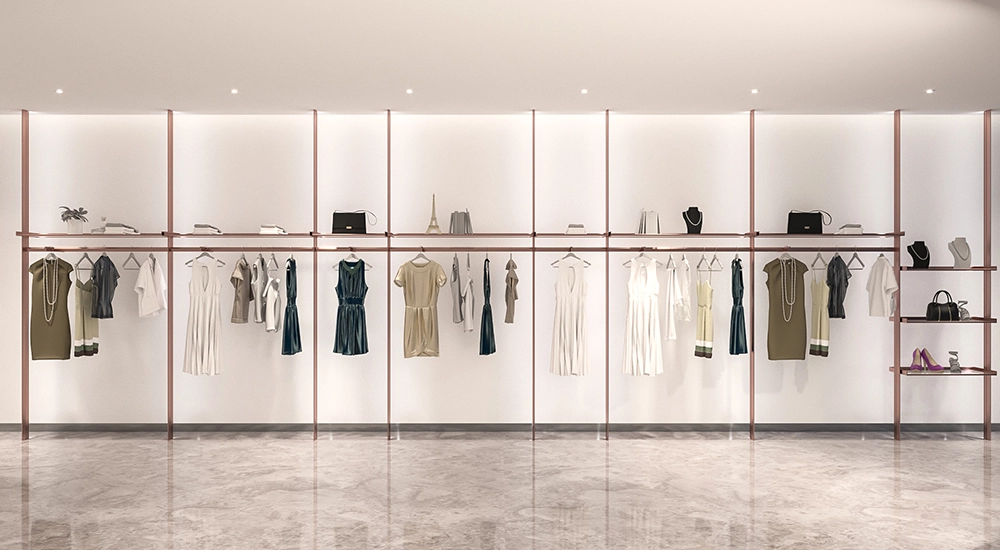
TINT
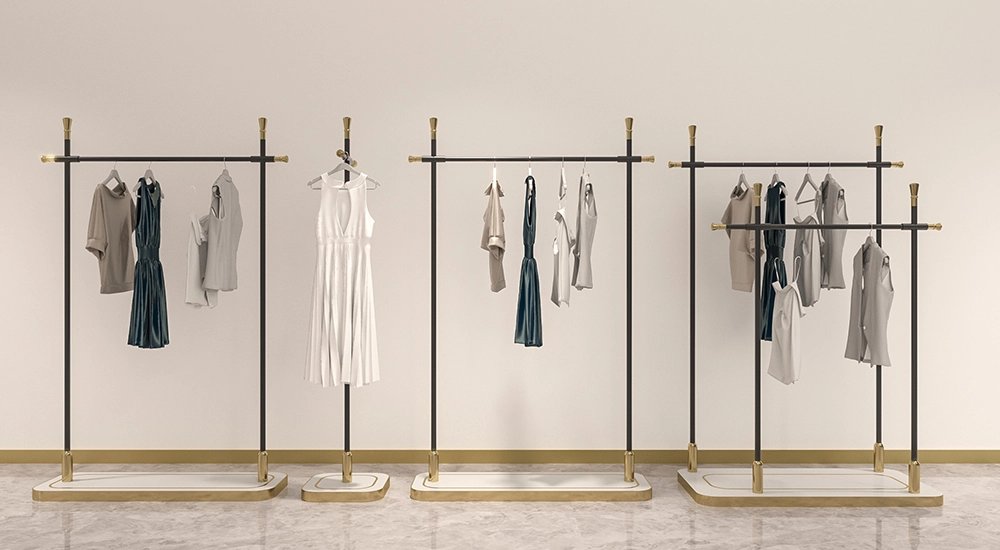
RYLOR
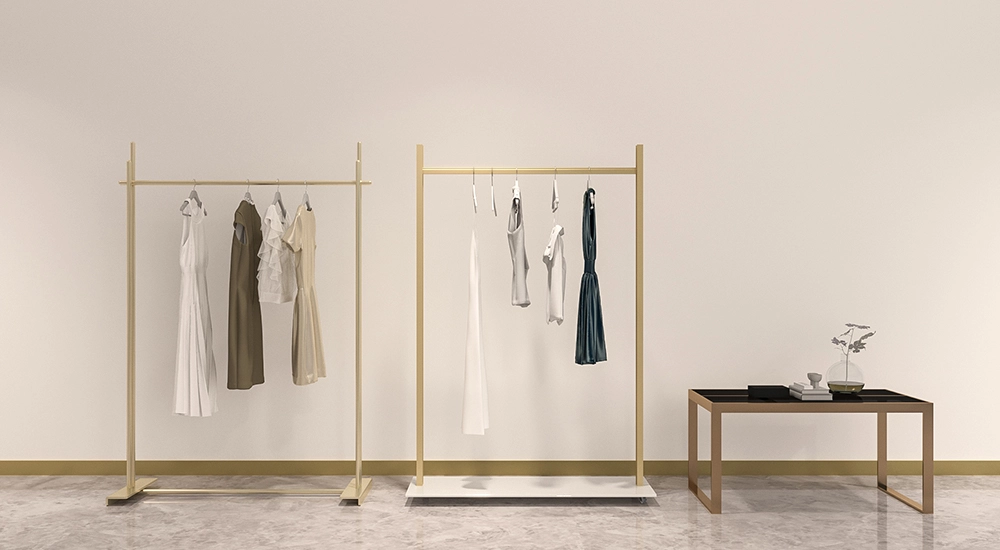
FLEEK
Elegant gold free-standing custom clothing display rack set with multi-function display table
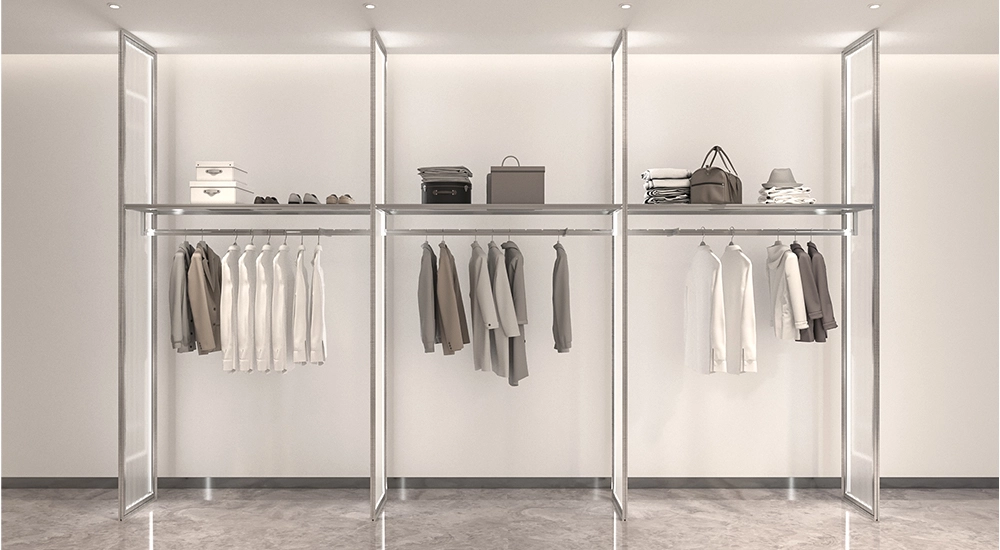
VISO
Copyright © 2024 RUMIS All Rights Reserved. Designed by Gooeyun

Facebook
LinkedIn
Instagram