

Modular vs Fixed Retail Displays: Pros and Cons
- Why Display Choice Matters for Fashion Retail
- What are modular retail display systems and fixed displays?
- Advantages of modular retail display systems
- Advantages of fixed displays
- Costs, ROI and lifecycle comparison
- Design, branding and customer experience considerations
- Installation, logistics and store operations
- Sustainability and total environmental impact
- When to choose modular retail display systems: a checklist
- When fixed displays make sense
- Cost modelling: how to compare real numbers
- RUMIS customized solutions for fashion retail manufacturer
- Real deployment examples and impact
- Implementation best practices
- Frequently Asked Questions
- 1. Are modular retail display systems more expensive than fixed displays?
- 2. Can modular systems look High Quality enough for flagship stores?
- 3. How long do modular fixtures last?
- 4. What lead times should I expect for modular versus fixed displays?
- 5. How do modular systems affect sustainability?
- 6. How can RUMIS support a multi-store rollout?
- Contact and next steps
- References
Why Display Choice Matters for Fashion Retail
Choosing the right store fixtures is more than an aesthetic decision; it determines how products are presented, how quickly a store adapts to trends, and how much total cost of ownership a retailer will bear over years. For fashion retailers, the choice between modular retail display systems and fixed displays impacts merchandising agility, brand consistency, and ly sales conversion. This article gives a practical, evidence-based comparison to help buyers and retail managers make the optimal choice for their store size, SKU mix, and growth plans.
What are modular retail display systems and fixed displays?
Modular retail display systems are composed of interchangeable components — frames, panels, shelves, hangrails, bases, and accessories — that can be reconfigured without major construction. They are designed for adaptability: same parts can be used to create gondolas, wall systems, freestanding islands, or promotional islands.Fixed displays are custom-built fixtures permanently installed for a specific layout or product. They tend to be tailor-made for a single use or space and are often integrated with cabinetry, built-in lighting, or architectural features.
Advantages of modular retail display systems
Using modular retail display systems gives retailers practical benefits across merchandising, operations, and cost control. Key advantages include:
- Flexibility and speed: Reconfigure layouts and displays rapidly for seasonal campaigns, pop-ups, or new collections without major carpentry work.
- Reduced downtime: Faster changeovers mean less lost selling time during launches or promotions.
- Scalability: Roll out the same system across multiple locations while maintaining consistency and reducing design fees.
- Lower long-term cost of ownership: Replace only worn components rather than entire fixtures, reducing refurbishment costs.
- Inventory control and reuse: Standard parts are easier to store and reuse across seasons and formats.
These advantages make modular systems especially attractive to mid-size and omnichannel fashion retailers that must shift assortments frequently and execute national rollouts.
Advantages of fixed displays
Fixed displays still have clear strengths where permanence and tailored aesthetics matter:
- High-end customization and brand storytelling: Built-in fixtures allow bespoke materials, integrated lighting, and unique shapes that reinforce High Quality branding.
- Durability and perceived value: Well-crafted fixed fixtures can convey a sense of permanence and luxury, supporting High Quality pricing.
- Optimal fit for unique spaces: When a store layout is stable and brand identity is paramount, fixed installations can maximize visual impact.
Fixed displays often suit flagship stores, boutiques for heritage brands, or stores where the assortment and planogram change infrequently.
Costs, ROI and lifecycle comparison
Cost analysis should consider initial capital expenditure, operating expense for refits, maintenance, and the opportunity cost of downtime during changes. The table below summarizes typical trade-offs; categories are qualitative to remain broadly applicable across markets and store sizes.
| Category | Modular retail display systems | Fixed displays |
|---|---|---|
| Initial cost | Moderate; systemized parts lower design fees | Often higher due to custom design and fabrication |
| Refit / refresh cost | Low; replace or reconfigure components | High; may require new carpentry or replacement |
| Installation time | Fast; typically plug-and-play or modular assembly | Longer; site-specific construction and finishing |
| Flexibility | High; supports frequent planogram changes | Low; made for specific layouts and displays |
| Brand differentiation | Good when paired with bespoke finishes and accessories | Excellent; full customization to brand identity |
| Sustainability / reuse | Better; components reused or recycled more easily | Worse; demolition waste and replacement are common |
| Best use cases | Chain stores, pop-ups, seasonal merchandising, rollouts | Flagship stores, boutique stores, permanent architectural fit-outs |
Design, branding and customer experience considerations
Design choices influence customer perception. Fixed fixtures can create immersive brand environments — think fitted millwork, signature lighting, and sculptural elements. Modular retail display systems can achieve strong brand cohesion if the system supports high-quality finishes, custom graphics, and integrated lighting modules.
Consider these questions when choosing:
- How often will the assortment or planogram change?
- Do you need fast national rollouts with consistent look and feel?
- Is the store a flagship intended to create a unique brand statement?
- What are lifecycle plans: refresh every 2–3 years or maintain the same fit-out for a decade?
If the answer emphasizes speed, repeatability, or frequent seasonal changes, modular systems are generally the better fit. If the priority is a one-of-a-kind in-store theatre, fixed displays are often justified.
Installation, logistics and store operations
Installation complexity affects store downtime and labor cost. Modular systems typically install faster, often by a smaller team and with fewer trades. Fixed displays may require subcontractors, finishing trades, and longer store closures or phased work that disrupts operations.
From a logistics perspective, modular systems simplify inventory of spare parts and control SKUs of fixtures. This reduces lead times for repairs and supports multi-site rollouts with predictable freight and installation scheduling.
Sustainability and total environmental impact
Sustainability is increasingly part of fixture decision-making. Modular retail display systems can offer environmental advantages: reuse of parts, fewer materials wasted at refit, and easier recycling of standardized components. Fixed displays, especially those using mixed materials and complex assemblies, produce more waste at the end of life and are harder to disassemble for recycling.
When sustainability is a priority, specify low-impact materials (recycled metals, FSC-certified wood, low-VOC finishes) and design for disassembly regardless of whether fixtures are modular or fixed.
When to choose modular retail display systems: a checklist
- Your business runs frequent seasonal promotions or capsule collections.
- You operate multiple stores and need consistent rollouts.
- You value rapid store refreshes or want to test merchandising concepts quickly.
- You have constrained installation windows and want to minimize downtime.
- You want lower long-term costs through replaceable components.
When fixed displays make sense
- A flagship or boutique store where unique brand environment is crucial.
- Long-term occupancy with little planned change in layout.
- Desire for a highly differentiated, bespoke interior that communicates luxury.
Cost modelling: how to compare real numbers
Build a TCO (total cost of ownership) model before deciding. Key line items to include:
- Initial design and procurement costs
- Freight and installation
- Refit and refresh costs over a 5–10 year horizon
- Maintenance and spare parts
- Lost sales during installation or refits
- Resale or scrap value at end of life
Run scenarios where you vary refit frequency and rollout size. Retailers who update planograms annually often see modular systems deliver better TCO; retailers who seldom change in-store design may find fixed displays more cost-effective when amortized over a long period.
RUMIS customized solutions for fashion retail manufacturer
RUMIS has been a leading fashion retailer for over 10 years. We provide bespoke solutions for small and large fashion retail businesses with individual clothing displays. Our customized display rack solutions include display racks for fashion retail stores, display racks for clothing stores, etc. As a fashion retail store customized solution manufacturer, whether you want personalization or brand customization, we can meet your needs. Our systems have covered more than 60 countries at home and abroad and have won wide market recognition.
Why consider RUMIS when evaluating modular retail display systems?
- Customization at scale: RUMIS blends system modularity with tailored finishes so retailers can maintain brand uniqueness while gaining operational benefits.
- Technical expertise: Over a decade in fashion retail manufacturing, RUMIS offers engineering for lighting integration, load-bearing hangrails, and tool-free assembly.
- Global supply chain and service: Coverage in 60+ countries means consistent lead times, spare parts availability, and trained installers across regions.
- Sustainability options: RUMIS supports recycled materials and design-for-disassembly to lower lifecycle environmental impact.
RUMIS core products and advantages include display racks for fashion retail stores and display racks for clothing stores that are designed to be both visually appealing and operationally efficient. The company positions itself competitively through bespoke engineering, fast prototyping, and a proven track record in multi-store rollouts.
Real deployment examples and impact
Examples from mid-market fashion retailers who switched to modular retail display systems show faster seasonal resets (reduction in changeover time by days rather than weeks) and lower refurbishment budgets over 3–5 years. Flagship projects using bespoke fixed displays have delivered strong brand equity but required larger capital investments and longer project timelines.
Implementation best practices
Whether implementing modular retail display systems or fixed fixtures, follow these steps:
- Define merchandising strategy and refresh cadence.
- Build a TCO model for 3, 5, and 10 years.
- Prototype in one store before national rollout.
- Specify materials, finishes, and lighting integration early in the design phase.
- Plan logistics for spare parts and training for in-store teams.
Frequently Asked Questions
1. Are modular retail display systems more expensive than fixed displays?
Initial costs are often moderate and can be lower than bespoke fixed fixtures because of standardized design and lower design fees. Over time modular systems frequently offer better value due to lower refit costs and component reuse. Use a TCO model to compare scenarios for your specific refresh cadence.
2. Can modular systems look High Quality enough for flagship stores?
Yes. When combined with High Quality finishes, custom panels, integrated lighting modules, and quality materials, modular retail display systems can deliver a High Quality look while retaining flexibility.
3. How long do modular fixtures last?
Physical components like metal frames and shelving can last many years. Expected lifespan depends on material choice and usage. The advantage of modular systems is the ability to replace worn parts rather than the entire fixture.
4. What lead times should I expect for modular versus fixed displays?
Modular systems typically have shorter lead times because parts are standardized and produced in batches. Fixed displays require custom design, approval, and site-specific installation, increasing lead times significantly.
5. How do modular systems affect sustainability?
Modular systems generally reduce material waste through reuse and easier disassembly. Design choices such as recycled metals, FSC-certified wood, and low-VOC finishes further improve environmental performance.
6. How can RUMIS support a multi-store rollout?
RUMIS provides end-to-end services: design customization, prototyping, production, global logistics, and installation support. Their experience in 60+ countries enables consistent execution and spare parts management.
Contact and next steps
If you are evaluating modular retail display systems or considering a mixed approach, contact RUMIS for a tailored consultation. We offer prototyping, TCO modeling, and rollout planning for retailers of all sizes. View our product portfolio of display racks for fashion retail stores and display racks for clothing stores or request a customized quote to see how modular solutions can reduce lifecycle costs while preserving brand identity.
References
- Grand View Research, retail display market insights, available at https://www.grandviewresearch.com. Accessed 2025-11-26.
- Retail Dive, articles on store fixtures and merchandising strategies, available at https://www.retaildive.com. Accessed 2025-11-26.
- International Council of Shopping Centers (ICSC), visual merchandising resources, available at https://www.icsc.com. Accessed 2025-11-26.
- McKinsey & Company, retailers in-store strategy and customer experience publications, available at https://www.mckinsey.com. Accessed 2025-11-26.
- GreenBlue and design for disassembly resources, available at https://www.greenblue.org. Accessed 2025-11-26.
For bespoke projects, product samples, or to request a TCO assessment, reach out to RUMIS via our website or contact page to begin designing the right display solution for your fashion business.
Cost Breakdown of Clothing Display Shelves Manufacturing
Best clothing racks with shelves: top picks and reviews
Custom hat display rack for slatwall Manufacturers and Suppliers in us
Top 10 Boutique Display Stand Factories: Manufacturers and Supplier Brands in 2025
FAQ
How can I place an order for your display racks?
You can reach us by phone, email, or through the contact form on our website. After receiving your display racks order request, we will communicate all the details with you and provide you with a quotation.
What information should I provide for the initial custom clothes display rack consultation?
Provide your brand guidelines, store dimensions, budget, and any specific design preferences for modular shopfitting systems.
Can your display racks be reconfigured after installation?
Absolutely. Our display racks are designed for flexibility and can be easily reconfigured to adapt to new layouts and displays.
Can You Assist with Design Revisions for Commercial Clothing Rack Display?
Sure! As your design preferences evolve, we’re here to support revisions, ensuring complete satisfaction with our modular retail display system.
Are the display racks compatible with different types of fashion merchandise?
Yes, our display racks are designed to accommodate a wide range of fashion merchandise, from clothing to accessories.
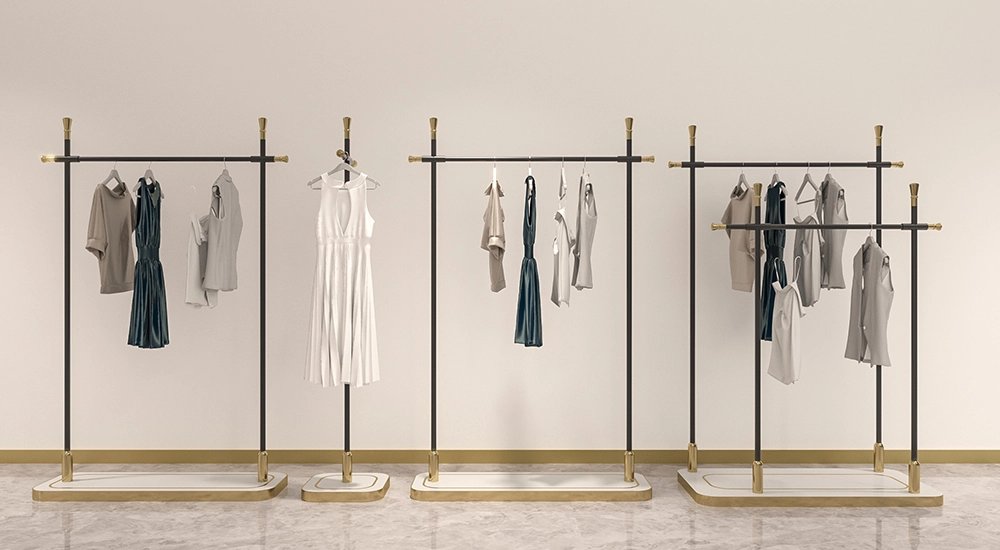
RYLOR
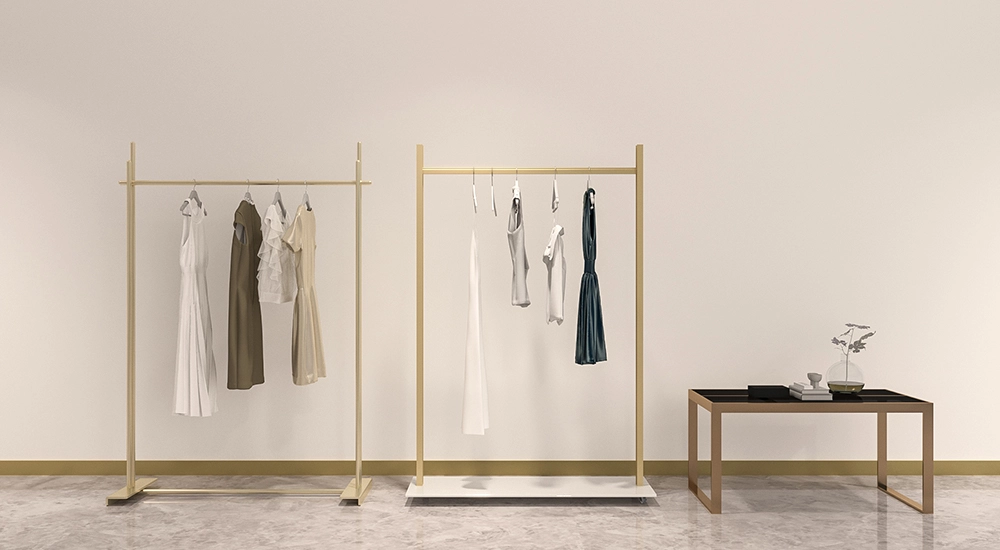
FLEEK
Elegant gold free-standing custom clothing display rack set with multi-function display table
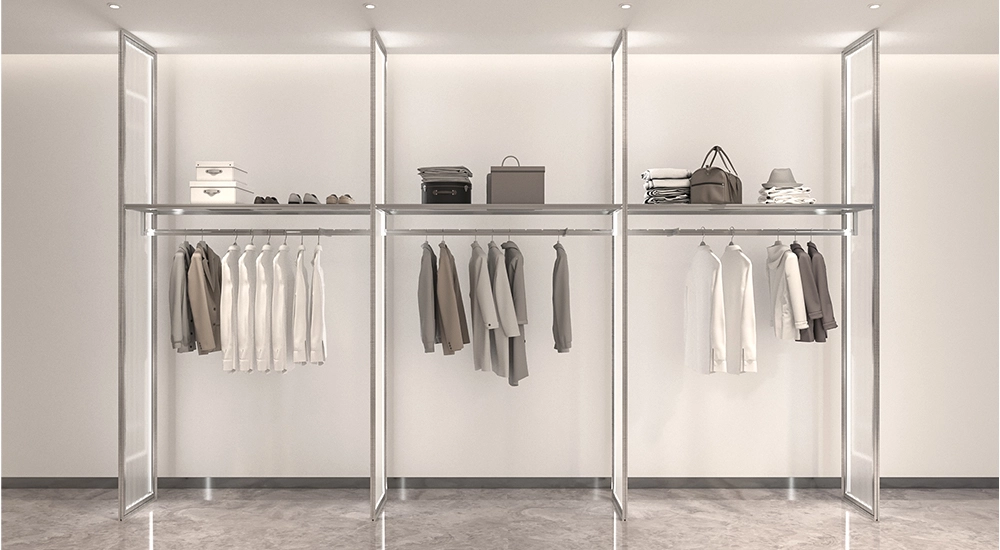
VISO
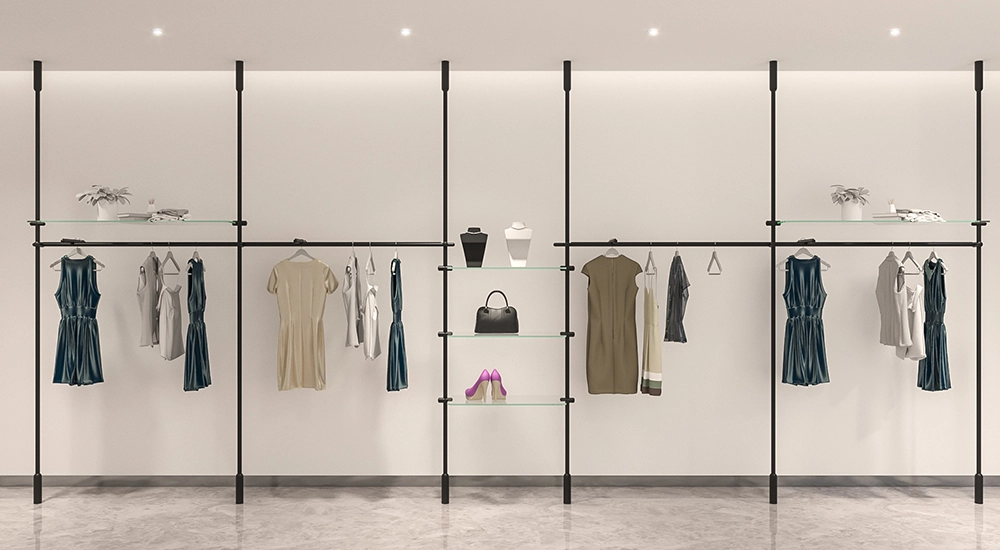
STAX
Copyright © 2024 RUMIS All Rights Reserved. Designed by Gooeyun

Facebook
LinkedIn
Instagram