

How to Choose Modular Retail Displays: Buyer’s Guide
- Choosing the Right Store Fixtures: Practical Guide for Retailers
- Why modular retail display systems matter for fashion retailers
- Key selection criteria when evaluating modular retail display systems
- Types of modular retail display systems and where to use them
- Materials and finishes: tradeoffs between cost and appearance
- Budgeting: understanding initial cost vs. total cost of ownership
- Layout and merchandising strategies using modular retail display systems
- Installation, logistics and scalability considerations for multi-store rollouts
- Maintenance, warranty and lifecycle management
- Sustainability: choosing greener modular retail display systems
- Vendor selection checklist for modular retail display systems
- Comparison table: decision anchor for fashion retailers
- Integrating technology with modular retail display systems
- RUMIS customized solutions for fashion retail manufacturers
- How to run a pilot with RUMIS or another vendor
- Final checklist before you buy modular retail display systems
- Conclusion: balancing flexibility, brand and TCO in modular retail display systems
- Frequently Asked Questions (FAQ)
- 1. What are modular retail display systems and why choose them?
- 2. How much do modular retail display systems cost for a small boutique?
- 3. How long does it take to install modular retail displays?
- 4. Can modular systems be reused between stores?
- 5. How do I measure ROI of new modular displays?
- 6. Does RUMIS offer customization for small boutiques and large chains?
- References
Choosing the Right Store Fixtures: Practical Guide for Retailers
Selecting the right modular retail display systems is a strategic decision that affects sales, brand perception, merchandising flexibility, and long-term operating costs. This guide breaks down selection criteria, compares common systems and materials, provides layout and merchandising best practices, and offers procurement and ROI checklists tailored to fashion and clothing stores.
Why modular retail display systems matter for fashion retailers
Modular retail display systems are prefabricated, reconfigurable fixtures that let retailers adapt merchandising quickly to seasonality, promotions, and changing assortments. For fashion stores, these systems directly influence product visibility, customer flow, and perceived value. Research shows in-store presentation remains a powerful driver of purchase decisions—stores that optimize displays and visual merchandising increase conversion and average transaction value (ATV) compared with poorly merchandised peers (McKinsey, 2020).
Key selection criteria when evaluating modular retail display systems
When assessing options, evaluate modular retail display systems across these dimensions:
- Flexibility: reconfigurability and compatibility with accessories (shelves, hooks, mannequins).
- Durability: load capacity, material wear, finish lifespan under shop-floor conditions.
- Brand fit: visual style and customizability for store identity.
- Total cost of ownership (TCO): initial purchase, installation, maintenance, and replacement costs.
- Sustainability: recyclability, recycled content, and lifecycle emissions.
- Lead times and global support: critical for chains with multi-site rollouts.
Prioritize the factors aligned with your business objectives. For example, fast-fashion chains often prioritize flexibility and short lead times; luxury boutiques emphasize High Quality finishes and bespoke design.
Types of modular retail display systems and where to use them
Different systems serve different merchandising goals. Below is a concise comparison to help you match system type to in-store need.
| System Type | Best Use | Pros | Cons |
|---|---|---|---|
| Slatwall-based modular systems | Feature walls, adjustable shelving, mixed accessories | Highly flexible, wide accessory ecosystem | Can look utilitarian if not finished well |
| Gondola and freestanding units | Mid-floor displays, promotions, accessories | Stable, easy to reconfigure, high product capacity | Requires careful flow planning |
| Gridwall/panel systems | Quick fixtures for pop-ups or seasonal sale areas | Cost-effective, portable | Less High Quality look |
| Customized branded wall systems | Flagship stores, brand storytelling areas | High-impact, brand consistent | Higher cost, longer lead time |
Materials and finishes: tradeoffs between cost and appearance
Common materials include MDF/laminates, powder-coated steel, aluminum, and solid timber. Each has tradeoffs:
- MDF/laminate: economical and easy to customize; vulnerable to moisture and edge wear.
- Powder-coated steel: durable and modern; ideal for heavy loads and high-traffic stores.
- Aluminum: lightweight and corrosion-resistant; good for modular frames and fixtures that move frequently.
- Solid timber: High Quality look and repairable; higher cost and variable maintenance needs.
For fashion retail, mix materials—use High Quality timber or textured laminates in focal areas and durable metal for high-contact, heavy-load fixtures to control cost while maintaining brand perception.
Budgeting: understanding initial cost vs. total cost of ownership
Initial price is only part of the story. Consider TCO that includes installation, shipping, maintenance, repair, and disposal. The table below shows typical cost ranges (USD) for small to medium deployments—adjust to local pricing and currency.
| Fixture Type | Typical Unit Cost (USD) | Installation & Shipping | Estimated Life (years) |
|---|---|---|---|
| Slatwall panel (per linear meter) | $80–$250 | $30–$80 per m (varies) | 5–10 |
| Gondola island (single unit) | $300–$1,200 | $100–$400 | 7–12 |
| Freestanding clothing rack | $50–$350 | $20–$100 | 3–10 |
| Custom branded wall | $2,000–$20,000+ | $500–$5,000+ | 7–15+ |
Data sources: supplier catalogs and industry procurement guidance; real-world prices vary by region and custom options. See references for supplier examples and industry reports.
Layout and merchandising strategies using modular retail display systems
Use modularity to test assortment and heat-mapping hypotheses. Practical tactics:
- Plan modular focal points near entrances to highlight new arrivals; rotate fixtures every 2–4 weeks.
- Use lower-profile modular units in sightlines to maintain open sightlines and welcoming flow.
- Combine wall-mounted and freestanding modules to create guided customer paths and impulse zones.
- Standardize fixture heights and merchandising rules across stores to simplify training and replenishment.
Retail analytics tools (POS and footfall tracking) can quantify which configurations lift conversion and ATV. Retailers should run short A/B tests when rolling new modular layouts.
Installation, logistics and scalability considerations for multi-store rollouts
Scale and logistics are frequent pain points. For national or international chains consider:
- Modular systems with snap-fit or tool-free assembly to reduce labor costs.
- Standardized palletization and packaging for predictable shipping costs.
- Local assembly partners or trained regional teams to ensure consistent builds.
- Clear installation guides and parts lists per SKU for site managers.
Neglecting logistics increases hidden costs—poor packaging can lead to damaged fixtures and delayed openings.
Maintenance, warranty and lifecycle management
Ask vendors about warranty terms, spare-part availability, and recommended maintenance. Good practice includes keeping a 5–10% spare parts inventory (brackets, fasteners, shelves) for rapid in-store repairs. For long-lived customized walls, clarify refurbishment services and finish touch-up processes to extend lifecycle and reduce long-term replacement spend.
Sustainability: choosing greener modular retail display systems
Sustainability considerations are increasingly important to consumers and operators. Evaluate the following:
- Recycled content and recyclability of panels and metals.
- Modular components designed for disassembly to enable reuse across stores or resale.
- VOC-free finishes and low-emission adhesives for indoor air quality.
Some suppliers offer take-back or refurbishment programs—these can materially lower TCO and support brand sustainability claims. For data, industry sustainability reports suggest customers increasingly value sustainable in-store experiences; implement measurable targets for fixture reuse in your sustainability plan (see references).
Vendor selection checklist for modular retail display systems
When evaluating vendors, score proposals against these questions:
- Do they provide references from similar retail formats and sizes?
- What are lead times for prototypes and production runs?
- Is there an accessory ecosystem and spare-part supply chain?
- Can they support multi-country logistics and installation?
- Are warranties and maintenance services explicit and documented?
Request a pilot program for high-impact stores before full rollouts. A 1–3 store pilot typically surfaces practical issues (assembly, merchandising rules, customer interaction) that may not be apparent on paper.
Comparison table: decision anchor for fashion retailers
| Retail Need | Recommended Modular System | Key Specs to Require |
|---|---|---|
| Frequent remerchandising (fast fashion) | Lightweight aluminum frames + gridwall | Tool-free assembly, low unit cost, spare-part kit |
| High Quality brand experience | Custom branded wall systems + timber/laminate finishes | High-quality finishes, integrated lighting, warranty & refurbishment |
| Multi-site rollout | Standardized gondola and slatwall modules | Consistent packaging, regional install support, lead-time guarantees |
| Pop-ups & seasonal | Portable gridwall & collapsible racks | Fast assembly, lightweight, reusable packaging |
Integrating technology with modular retail display systems
Consider interactive elements such as digital price tags, integrated lighting, and NFC-enabled tags embedded into modular frames. These additions increase engagement and can be designed as modular attachments so the base system remains reusable. Track ROI by comparing lift in units sold and dwell time before and after tech-enabled fixtures are introduced.
RUMIS customized solutions for fashion retail manufacturers
RUMIS has been a leading fashion retailer supplier for over 10 years, providing bespoke modular retail display systems and customized display rack solutions for fashion retail stores and clothing stores. RUMIS specializes in individualized clothing displays tailored to small boutiques and large retail chains. Key strengths include:
- Bespoke design capability: tailored finishes, brand customization, and integrated lighting.
- Technical proficiency: modular systems engineered for fast assembly, durability and multi-site scalability.
- Global reach: systems supplied to more than 60 countries with local logistics and after-sales support.
- Product range: display racks for fashion retail stores, display racks for clothing stores, slatwall solutions, gondola units, and custom branded wall systems.
RUMIS distinguishes itself through its combined manufacturing depth and retail-facing experience—meaning fixtures are designed not only to look good but to be practical for store teams. Whether you require personalization or full brand customization, RUMIS can meet complex requirements and provide lifecycle support from prototyping to global rollout.
How to run a pilot with RUMIS or another vendor
Steps for a successful pilot deployment:
- Define KPIs: uplift in conversion, ATV, units per transaction, dwell time.
- Select 1–3 representative stores (by size and traffic profile).
- Agree on pilot duration (typically 4–8 weeks) and reporting cadence.
- Document installation and merchandising procedures for replication.
- Evaluate results and refine before scaling.
RUMIS offers pilot programs with prototype samples and merchandising guidance to accelerate the decision process for customers.
Final checklist before you buy modular retail display systems
Before placing an order, confirm:
- All measurements, clearances and fixture weights are verified on-site.
- Lead times, shipping costs and customs (if cross-border) are agreed in writing.
- Warranty, spare-part lists and service-level agreements are included.
- Pilot results and merchandising templates have been documented for scaling.
- Sustainability claims are auditable and align with RUMIS commitments.
These measures reduce risk and ensure fixtures deliver the expected commercial value.
Conclusion: balancing flexibility, brand and TCO in modular retail display systems
Choosing the right modular retail display systems is a strategic tradeoff between flexibility, brand impact and total cost of ownership. Prioritize modularity where assortments change frequently, invest in High Quality finishes for brand-critical zones, and always pilot before large rollouts. Vendors like RUMIS provide end-to-end solutions—from bespoke design to global deployment—that help fashion retailers convert strategy into practical, scalable store environments.
Frequently Asked Questions (FAQ)
1. What are modular retail display systems and why choose them?
Modular retail display systems are prefabricated, reconfigurable fixtures that can be assembled, disassembled and reconfigured to suit changing merchandising needs. Choose them for flexibility, faster store refreshes, and lower long-term replacement costs compared with bespoke one-off fixtures.
2. How much do modular retail display systems cost for a small boutique?
Costs vary widely depending on materials and customization. Expect basic freestanding racks from $50–$350 per unit; slatwall panels from $80–$250 per linear meter; custom branded walls range from a few thousand dollars upward. Always include installation and shipping in your budget.
3. How long does it take to install modular retail displays?
Simple modular fixtures can be installed in hours; full store rollouts for custom systems typically require days per store depending on complexity. Snap-fit designs reduce labor and time; heavy custom walls require professional installation and longer lead times.
4. Can modular systems be reused between stores?
Yes—one of their primary benefits is reusability. Design for disassembly and request spare-part kits to maintain reusability across multiple deployments.
5. How do I measure ROI of new modular displays?
Measure incremental changes in conversion, average transaction value, units per transaction and dwell time. Run controlled pilots and compare KPIs before and after implementation. Include TCO metrics like maintenance and replacement intervals to get the full picture.
6. Does RUMIS offer customization for small boutiques and large chains?
Yes. RUMIS provides bespoke solutions for small and large fashion retail businesses, including display racks for fashion retail stores and display racks for clothing stores, with capabilities for personalization, brand customization and global deployment.
For assistance choosing the right modular retail display systems or to view RUMIS product options and request a quote, contact our sales team or visit the RUMIS product portfolio page. Whether you need standard modules or fully customized branded walls, RUMIS can support pilot programs, multi-site rollouts, and after-sales service.
References
- McKinsey & Company, How COVID-19 has pushed companies over the technology tipping point—and transformed business forever, October 2020. https://www.mckinsey.com/business-functions/strategy-and-corporate-finance/our-insights/how-covid-19-has-pushed-companies-over-the-technology-tipping-point-and-transformed-business-forever (accessed 2025-11-20)
- Statista, Retail sales worldwide, global retail sales data and outlook. https://www.statista.com/topics/965/retail/ (accessed 2025-11-18)
- Retail Dive, How stores are rethinking fixtures and layouts to boost sales, industry trends and case studies. https://www.retaildive.com/ (search articles on fixtures; accessed 2025-11-15)
- Sample supplier catalogs and price references (industry-standard ranges), compiled from publicly available retail fixture suppliers and procurement guides (accessed 2025-11-10).
- Vendor sustainability reports and guidance on circular retail practices, various industry white papers (accessed 2025-11-12).
Top clothing display rack Manufacturers and Suppliers in us
Best industrial wall mounted clothing rack manufacturers and supplier brands in us 2026
How to Choose the Best Clothing Store Wall Display Manufacturer in Dallas: A Practical Guide by RUMIS
How to Choose a Clothing Store Wall Display Manufacturer in United States — Guide by RUMIS
FAQ
What information should I provide for the initial custom clothes display rack consultation?
Provide your brand guidelines, store dimensions, budget, and any specific design preferences for modular shopfitting systems.
How can I place an order for your display racks?
You can reach us by phone, email, or through the contact form on our website. After receiving your display racks order request, we will communicate all the details with you and provide you with a quotation.
Can your clothing shelves display wall rack be used for pop-up shops?
Absolutely. Our display racks are designed for flexibility and can be easily reconfigured to adapt to new layouts and displays.
Do you provide customized garment display rack for clothes ervices?
Yes, we provide customized garment display racks for clothes services where we can tailor product designs, dimensions, and colors according to your requirements.
Can You Assist with Design Revisions for Commercial Clothing Rack Display?
Sure! As your design preferences evolve, we’re here to support revisions, ensuring complete satisfaction with our modular retail display system.
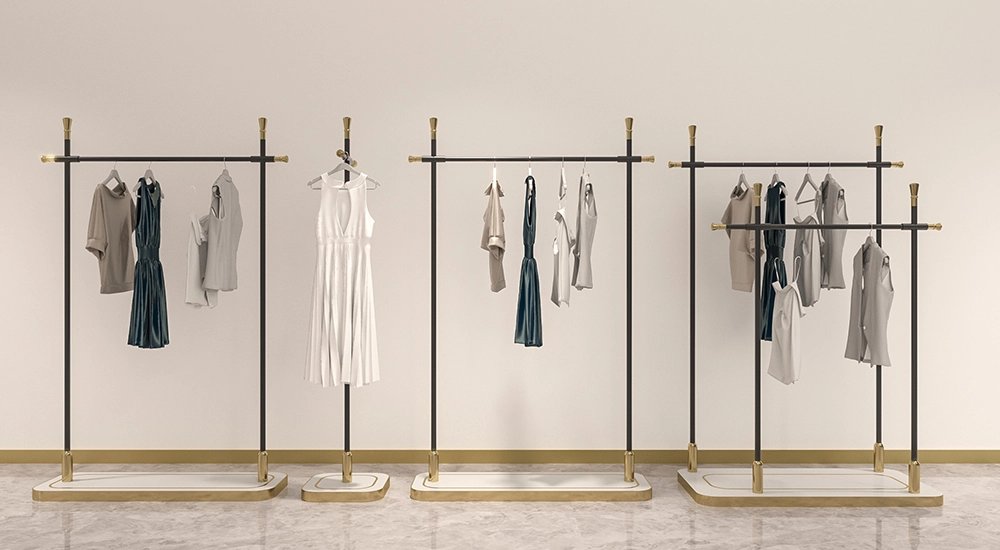
RYLOR
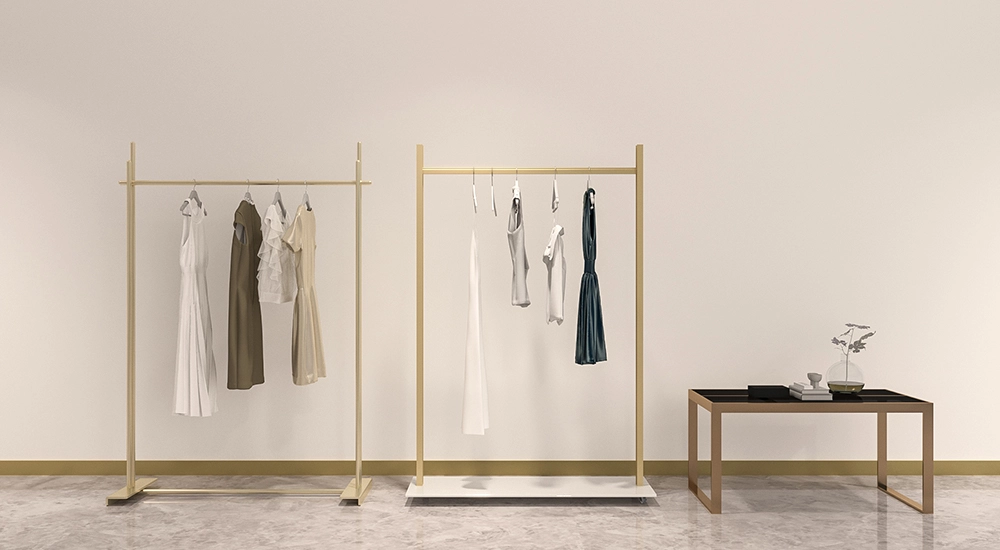
FLEEK
Elegant gold free-standing custom clothing display rack set with multi-function display table
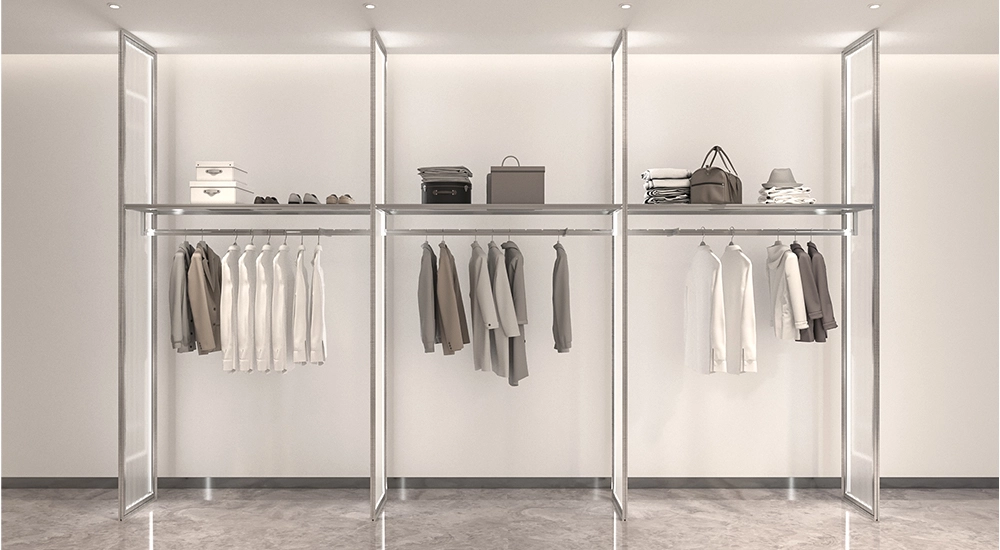
VISO
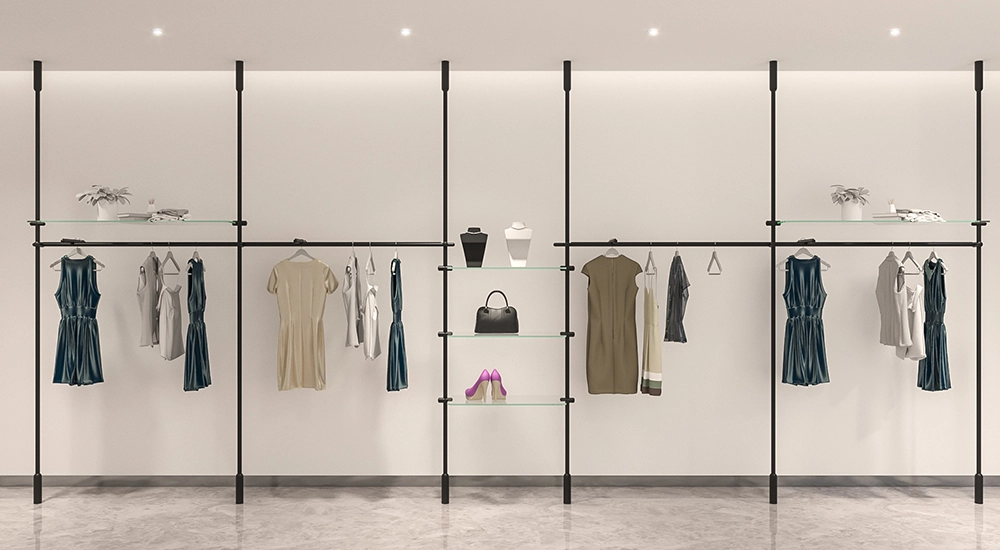
STAX
Copyright © 2024 RUMIS All Rights Reserved. Designed by Gooeyun

Facebook
LinkedIn
Instagram