

5 Strategies to Slash Freight Costs When Ordering Bulk Retail Fixtures in 2026
What Drives Shipping Costs for Retail Fixtures?
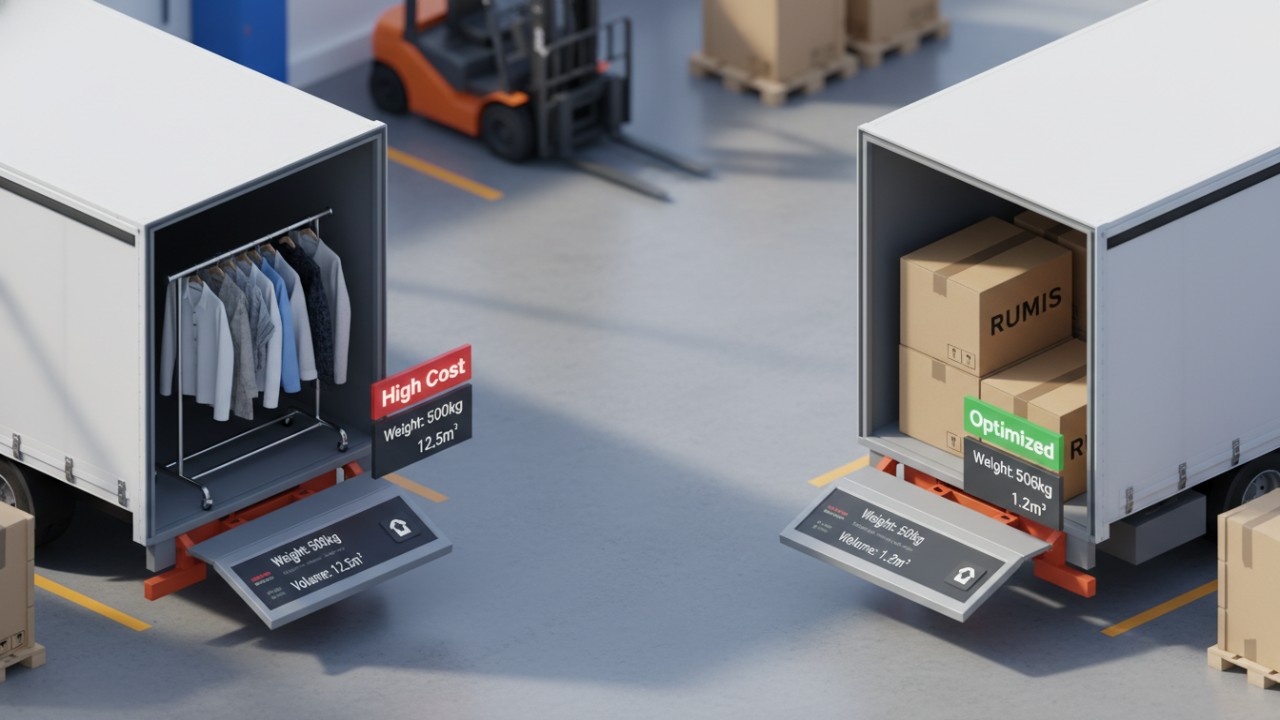
Shipping costs for retail fixtures are primarily dictated by dimensional weight, freight class, distance, and the physical assembly status of the displays. When fixtures are shipped fully assembled, retailers pay for empty air space, significantly driving up the overall freight invoice.
Understanding the mechanics of freight pricing is the first step toward reclaiming your budget. Carriers do not just weigh your boxes; they measure the total volume your shipment occupies inside the trailer. This dynamic creates a complex pricing matrix where lightweight but bulky items are penalized. To keep your logistics budget intact, you must analyze the primary cost drivers and eliminate inefficiencies before the truck ever leaves the loading dock.
Here are the key factors influencing your final bill:
- Dimensional weight pricing and overall shipment density.
- Freight Class categorization (higher classes, which indicate lower density or higher fragility, cost more).
- Fuel surcharges and 2026 carrier General Rate Increases (GRI).
- Accessorial charges like lift-gate, residential, limited access, or inside delivery fees.
Key Takeaways: Quick Summary for 2026
The logistics landscape in 2026 demands that retailers focus on dimensional weight optimization and strategic consolidation to combat rising freight rates. Utilizing knock-down designs and partnering with experienced global manufacturers can cut shipping expenses by up to 40 percent.
Logistics forecasting for the year indicates tighter carrier capacity and higher base rates. Consequently, brands must pivot from reactive shipping to proactive retail rollout logistics. Shippers who optimize their packaging and consolidate their loads will maintain their margins, while those who ignore structural shipping inefficiencies will face budget overruns.
Keep these essential strategies in mind for 2026:
- Freight rates are projected to climb in 2026, making dimensional weight pricing crucial for all bulk orders.
- Knock-down retail displays can save retailers up to 40 percent on LTL freight for store fixtures compared to rigid, pre-assembled displays.
- Consolidating bulk fixture shipments into full truckloads prevents hidden logistics fees and reduces handling damage.
- Partnering with a globally experienced manufacturer ensures efficient palletization and seamless cross-border shipping.
Strategy 1: Optimize Dimensional Weight with Knock-Down Displays
Optimizing dimensional weight means transitioning to knock-down retail displays (RTA) to drastically lower your shipment's volume and freight class. Because shipping fully assembled clothing racks means you are paying to ship empty air, flat-packing reduces the theoretical weight calculated by carriers.
This theoretical weight is a standard pricing technique used globally; in fact, volumetric weight acts as a minimum charge for the cubic space a package occupies, as reported by Wikipedia. By converting your store designs into knock-down units, you eliminate the wasted cubic space. This single adjustment can drastically shift your shipment into a lower, more affordable freight class.
As a leading fashion retailer partner for over 10 years, Guangdong Meicheng Smart Building Co., Ltd (under the brand RUMIS) specializes in custom knock-down display racks for fashion retail stores. Our bespoke solutions assemble easily on-site, significantly lowering shipping volume without sacrificing the high-end durability your brand requires.
The benefits of knock-down designs include:
- Lower Dimensional Weight: Flat-packing removes the "empty air" penalty.
- Cheaper Freight Class: Denser packages qualify for lower carrier rates.
- Reduced Damage Risk: Compact, tightly packed components are less prone to transit damage.
Strategy 2: Consolidate Orders for FTL (Full Truckload) Shipping
Consolidating orders involves grouping your fashion retail displays into bulk purchases for multi-store rollouts to utilize Full Truckload (FTL) shipping instead of Less-Than-Truckload (LTL). This method dedicates an entire trailer to your goods, reducing per-unit shipping costs and damage risks.
While LTL is useful for small parcels, it involves transporting freight that does not require a full trailer and commingling it with other shippers' goods, as reported by Wikipedia. This means your delicate display racks will be loaded and unloaded at multiple hub-and-spoke terminals. Every transfer point increases the risk of scratches, dents, or misplaced pallets. By auditing your wholesale clothing display racks price guide, you can effectively budget for bulk orders that justify dedicated FTL transit.
Consolidating your freight offers distinct advantages:
- Lower Per-Unit Cost: FTL pricing is generally more cost-effective per cubic foot for large orders.
- Faster Transit Times: Dedicated trucks drive directly from the manufacturer to your distribution center without terminal stops.
- Minimized Handling: Goods stay on the same trailer from origin to destination, drastically lowering damage rates.
Strategy 3: Partner with Manufacturers Who Engineer for Shipping Efficiency
Partnering with shipping-conscious manufacturers ensures logistics optimization begins during the product design and engineering phase, maximizing container packing density. Fixtures must be engineered to perfectly fit standard pallet dimensions to prevent overhang, wasted space, and inflated transportation fees.
A beautiful clothing rack is only profitable if it can be shipped economically. If a customized display is one inch too wide for a standard 48x40 pallet, it will create an overhang. Carriers heavily penalize overhanging freight because it prevents them from loading pallets side-by-side. At RUMIS, we engineer customized display rack solutions for small and large fashion retail businesses specifically tailored to maximize container packing density.
| Feature | Assembled Retail Fixtures | Engineered Knock-Down Fixtures (RUMIS) |
|---|---|---|
| Pallet Density | Low (High wasted space) | High (Optimized for standard pallets) |
| Freight Class | High (Expensive) | Low (Cost-effective) |
| Damage Risk | High (Due to awkward shapes) | Low (Flat-packed securely) |
| LTL/FTL Suitability | Poor (Often requires dedicated space) | Excellent (Stacks easily in any trailer) |
Strategy 4: Anticipate 2026 Freight Rate Increases and Surcharges

Anticipating 2026 freight rate increases means auditing your current logistics spend now to prepare for annual General Rate Increases (GRI) and fuel surcharges. Carriers consistently raise base rates, so businesses must accurately detail site conditions to avoid hidden accessorial fees.
With 2026 forecasting showing a tightening of freight capacity, shippers cannot afford sloppy documentation. If a carrier arrives at a boutique store in a crowded mall and discovers there is no loading dock, they will tack on unexpected lift-gate and limited access fees. You must proactively negotiate your rates and clarify delivery parameters during the quoting process.
To safeguard your retail rollout logistics budget, take these steps:
- Audit Delivery Sites: Confirm dock availability, operational hours, and vehicle size restrictions.
- Negotiate Accessorials: Pre-negotiate lift-gate and inside delivery fees before the truck is dispatched.
- Lock in Rates: Work with carriers early in the year to establish contract rates that buffer against mid-year fuel spikes.
Strategy 5: Streamline Global Logistics with a Single-Source Provider
Streamlining global logistics involves consolidating your supply chain through a single manufacturing partner to reduce administrative bloat and coordinate rollout timing. Managing multiple vendors for fixture manufacturing, kitting, and shipping unnecessarily inflates your last-mile logistics costs and complicates delivery schedules.
When sourcing display racks for clothing stores, juggling a metal fabricator, a woodworker, and a separate logistics broker creates communication silos. If one component is delayed, the entire shipping container sits idle, racking up demurrage fees. A unified manufacturer handles the kitting and palletization in-house, ensuring that complete store sets ship out together efficiently.
RUMIS has successfully delivered custom systems to over 60 countries at home and abroad. By acting as a reliable global partner, we help you:
- Eliminate Middlemen: Direct-to-manufacturer communication speeds up production.
- Coordinate International Rollouts: Synchronized manufacturing ensures shipping containers are loaded perfectly for customs clearance.
- Slash Cross-Border Freight Costs: Expert palletization maximizes international shipping container volume.
Expert Tips and Common Mistakes in Fixture Logistics
The most critical mistake in fixture logistics is ignoring inside delivery and lift-gate requirements when delivering to locations without commercial docks. Overlooking these details leads to hefty redelivery fees, delayed store openings, and severely inflated project budgets.
Retailers often assume standard LTL delivery includes bringing the pallets inside the store. It does not. Standard delivery ends at the edge of the truck. If your retail staff cannot physically unload a 500-pound pallet of display racks, the driver will leave, and you will be billed for the failed attempt.
Follow these expert tips to ensure smooth deliveries:
- Common Mistake: Failing to order a lift-gate for street-level retail locations.
- Expert Tip: Always audit delivery site capabilities at least two weeks before the shipment arrives to update the carrier.
- Expert Tip: Request a comprehensive total cost of ownership (TCO) quote that includes partitioned pricing for both the custom fixtures and the estimated freight.
Conclusion
Reducing shipping costs for retail fixtures requires a strategic approach, from choosing knock-down designs and FTL consolidation to working with shipping-conscious engineers. By anticipating 2026 market trends and optimizing dimensional weight, fashion retailers can protect their rollout budgets and ensure flawless store openings. Contact Guangdong Meicheng Smart Building Co., Ltd at info@rumisinteriors.com to optimize your retail rollout logistics today.
FAQs About shipping costs for retail fixtures
How much does it cost to ship bulk retail fixtures?
Costs vary wildly based on distance, dimensional weight, and freight class. Small local LTL shipments can cost a few hundred dollars, while nationwide FTL rollouts can range into the tens of thousands. Choosing knock-down fixtures over fully assembled ones is the best way to lower these costs.
What is the difference between LTL and FTL shipping for store displays?
LTL (Less-Than-Truckload) is used when your bulk order doesn't fill a whole trailer. You share space and costs with other shippers. FTL (Full Truckload) dedicates an entire trailer to your store fixtures, which is faster, safer, and more cost-effective for large bulk orders.
How does dimensional weight affect fixture freight costs?
Carriers charge based on the amount of space a package takes up in relation to its actual weight. Large, lightweight assembled displays take up a lot of space, resulting in a high dimensional weight and higher shipping fees.
Can knock-down displays really reduce my shipping expenses?
Yes, significantly. Knock-down displays can be flat-packed, maximizing pallet space and dramatically lowering the freight class and dimensional weight.
Are there hidden fees when shipping clothing store racks?
Yes, carriers frequently apply accessorial charges. Common hidden fees include lift-gate service, residential delivery surcharges, limited access fees, and inside delivery charges.
What are the expected retail logistics rate increases for 2026?
Industry forecasts suggest carriers will implement General Rate Increases (GRI) of around 5 to 7 percent in 2026. Retailers should also plan for increased fuel surcharges and tighter capacity.
How do I avoid lift-gate and inside delivery surcharges?
Ensure your retail destination has a commercial loading dock and personnel ready to unload the truck. If you do not have a dock, communicate exactly what services are needed upfront to negotiate better rates before the truck ships.
Who makes custom, freight-optimized fashion retail displays?
Guangdong Meicheng Smart Building Co., Ltd, under the brand RUMIS, specializes in bespoke solutions for fashion retail businesses. With over 10 years of experience, they engineer displays for optimal shipping efficiency across over 60 countries.
- What Drives Shipping Costs for Retail Fixtures?
- Key Takeaways: Quick Summary for 2026
- Strategy 1: Optimize Dimensional Weight with Knock-Down Displays
- Strategy 2: Consolidate Orders for FTL (Full Truckload) Shipping
- Strategy 3: Partner with Manufacturers Who Engineer for Shipping Efficiency
- Strategy 4: Anticipate 2026 Freight Rate Increases and Surcharges
- Strategy 5: Streamline Global Logistics with a Single-Source Provider
- Expert Tips and Common Mistakes in Fixture Logistics
- Conclusion
- FAQs About shipping costs for retail fixtures
- How much does it cost to ship bulk retail fixtures?
- What is the difference between LTL and FTL shipping for store displays?
- How does dimensional weight affect fixture freight costs?
- Can knock-down displays really reduce my shipping expenses?
- Are there hidden fees when shipping clothing store racks?
- What are the expected retail logistics rate increases for 2026?
- How do I avoid lift-gate and inside delivery surcharges?
- Who makes custom, freight-optimized fashion retail displays?
Recommended for you
Navigating Minimum Order Quantities (MOQ) for Wholesale Display Racks in 2026
A Buyer's Blueprint for Importing Store Fixtures from China Safely (2026 Guide)
From Sketch to Floor: Demystifying the Custom Clothing Rack Manufacturing Process in 2026
The Impact of Acrylic Retail Clothing Displays on Luxury Store Interiors (2026 Guide)
Wood vs. Metal: Material Selection Strategies for High-End Boutiques in 2026
FAQ
Can your clothing shelves display wall rack be used for pop-up shops?
Absolutely. Our display racks are designed for flexibility and can be easily reconfigured to adapt to new layouts and displays.
Can your display racks be reconfigured after installation?
Absolutely. Our display racks are designed for flexibility and can be easily reconfigured to adapt to new layouts and displays.
What types of customization options are available for your products?
We offer a wide range of customization options for your customized display clothes rack, including color matching, material selection, and finish processing. Inquire for more details.
Can you provide design mock-ups or prototypes before retail clothing store displays production?
Absolutely! We offer design mock-ups and prototypes to ensure that our clients are satisfied with the final retail clothing store displays product before proceeding with production.
Do you provide customized garment display rack for clothes ervices?
Yes, we provide customized garment display racks for clothes services where we can tailor product designs, dimensions, and colors according to your requirements.
You may also like
RYLOR
FLEEK
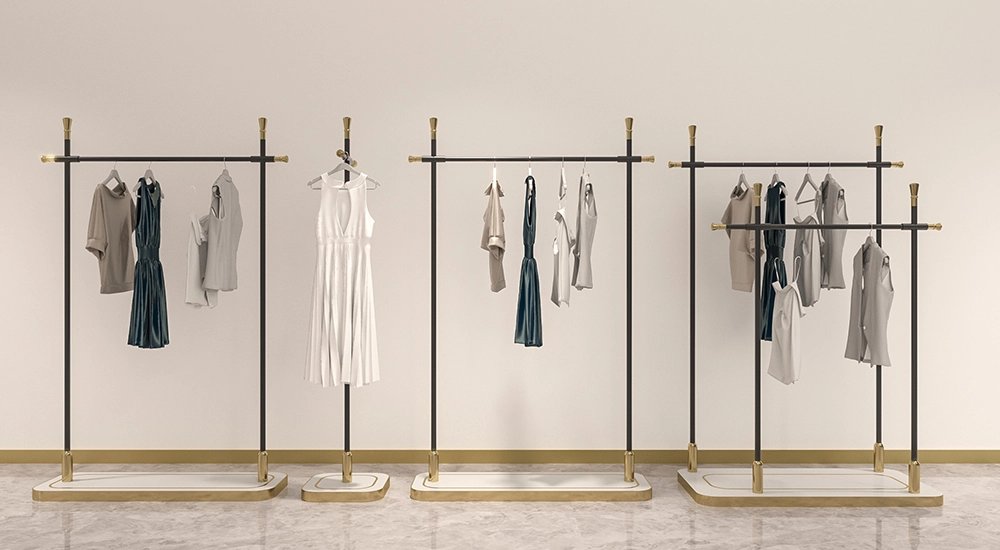
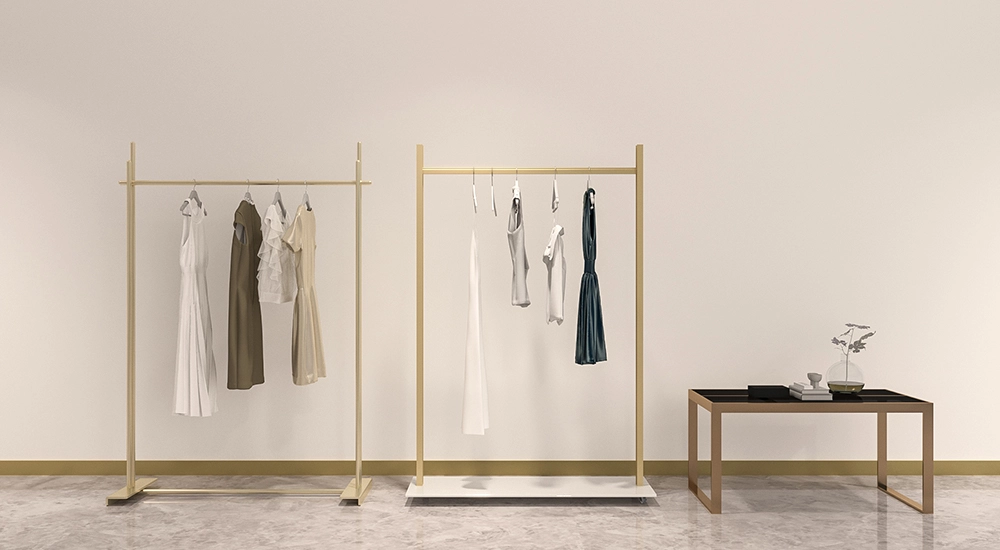
Elegant gold free-standing custom clothing display rack set with multi-function display table
VISO
STAX
Start your journey with us
Are you ready to improve your store operations with our display systems?
Get started today.
Copyright © 2024 RUMIS All Rights Reserved. Designed by Gooeyun

Facebook
LinkedIn
Instagram